You can find the How Many Dudes? demo all over the Web. After playing it a bit on itch.io, I installed the Steam version on my Steam Deck — and the “demo” is virtually a whole game in itself. Give it a try if you need a bit of lighthearted laughter.
What a great, ridiculous, funny break from reality’s responsibilities! Fortunately, my Steam Deck needs recharging right now, so I can get back to work.
Vampire illustration by Sanford Kossin from Beyond Fantasy Fiction (1953)
As promised, an apolitical post this time around
What is it about vampires that so captures our imagination? Lately I’ve unearthed a couple of old vampire PC games that used to keep me up into the wee hours. I buried myself in the puzzle getting them to fly on my Steam Deck, and have been drinking in once again their ambiance and action. One is Vampire: The Masquerade – Bloodlines, released in 2004; the other is Dark, released in 2013.
(Before I go on, let me say that playing these games with joysticks is sooo much better than with mouse and keyboard, especially when traversing those spiral stairs in Maximilian Straus’s house in Bloodlines.)
The Steam Deck puzzles for running each of these games have been absorbing tasks, a welcome distraction from the headlines.
Neither game is supported in the Deck’s Arch Linux build, but for Bloodlines the adaptation process is fairly well documented here and there online. Which is not surprising, given the game retains an amazingly large and active fan base even now, 25 years after its release. In fact, part of my impetus for playing again has been the recent release of a few pretty amazing fan mods.
The most important of the Bloodlines mods is the “Unofficial Patch,” without which pretty much none of the rest would work. This patch fixes some bugs from the original game, also restoring character options, maps, and side quests that were trimmed for the game’s original release, but whose files remained in hidden folders of the program. Those restorations alone have extended the game’s life throughout the decades. It even restores a completely new set of endings for the story, for players willing to join the Sabbat. Built on that patch, most Bloodlines mods follow the original storyline but add a few extra features such as extra clan choices or new side quests.
Of the Bloodlines mods, War Games is the first I’ve encountered that completely ditches the original story line and maps, replacing them with a World War II mission. When I first played War Games several years ago, the code was still somewhat buggy but playable. Since then it has been smoothed out quite a lot. Granted, without a professional budget, the mod’s voice acting remains minimal, sometimes jarring—the result a mix of dialog that’s sometimes human voice, sometimes AI, and sometimes merely text dialog. Frankly I prefer the text, with my mental ear filling in, especially for Sebastian LaCroix, who plays a minor role here but a central role in the original game.
Preludes I and II are a pair of more recent mods that have blown me away with their quality is Preludes I and II. A Preludes III is in the offing, to continue the trilogy. Preludes together are a story line placed immediately before the events of the original game—and that includes a couple of significant spoilers, so you should definitely play the original beforehand. As a part-time labor of love, the trilogy’s development progresses in fits and starts, and II still has a couple of side quests that remain unfinished. But even now, that pair of mods is so, so satisfying, with some real surprises. I’ve talked with the developer a bit by email, and plans for Prelude III have me very excited.
Turning to the second game … getting Dark to run on the Steam Deck is a much more difficult task. The game is much less popular, to say the least, so there’s nearly no discussion online of Linux adaptation, and virtually zero of potential Steam Deck use. In fact, had I not also tried the game on a Linux desktop installation, I’d’ve had no clue as to why it was launching nothing but a black screen on the Deck.
But on the desktop, I discovered that starting up the game first opens a Kalypso Media pop-up that connects to their website, and you have to click “Launch” on that pop-up screen to load the game. I ventured a guess that the Deck was choking on that pop-up, and I searched online for a way to disable that. Eventually I discovered a tactic of adding a “127.0.0.1 launcher01.kalypsomedia.com” line of text to the end of the Deck’s “/etc/hosts” file, redirecting the pop-up to the Deck itself as host, instead of the online site. Yeah, it sounds pretty arcane to me, too, and locating that hidden “hosts” file wasn’t easy. So you can imagine my satisfaction when it worked.
Honestly, part of why I enjoy dicking around with these tech puzzles is the gratification of subverting a system, making it do things outside its intended parameters. (See my “Playing the Oddball Options” post for some examples of subverting some TCGs.)
I mentioned above that Dark is “a much less popular game, to say the least.” Frankly, it gets hated on quite a lot, and I understand why: The dialog and voice acting are hackneyed noir; the story line is utterly linear, the movement options are sometimes frustratingly limited, and you’re pretty much forced to develop the character’s skills into a few specific choices, because the combat skills are lame. It’s clearly not an open-world first-person shooter.
But it ticks off three check boxes for me. Firstly, I like “walking games,” a category in which the experience of the journey is the whole point. Journey and Dear Esther are the epitome of the form for me. So Dark’s linear plot is satisfying. Secondly, I love puzzle solving, and I find traversing each locale in Dark thoroughly engaging. That the product includes a handful of separate “Challenge” maps outside of the main game adds to that satisfaction. And finally, the vampire’s shadow powers in this game feel so frickin’ cool! As a result, I can ignore the fact that I ought to be able to climb a particular hedge and can’t, or jump to a particular fire escape and can’t, for the sake of a game that let’s me jump halfway across the screen as an embodiment of shadow.
YMMV
Okay, before closing out this post, let me touch on something I absolutely hate about Bloodlines and find a bit irritating in Dark: the excessive objectification of females.
Yes, the vampire is a seductive, predatory creature in fiction. It is effectively a sort of incubus or succubus, and its prey is often drawn in by that sexuality. I’ve no complaint about the same being true in a game. As long as it’s true for all genders.
But you can’t swing a dead cat in Bloodlines without hitting a female hooker, and nearly every back alley has some woman performing fellatio on some guy in business clothes. Add in that one of the cheat codes is specifically for breast size, and the design team seems a stereotypical bunch of horny teenage boys with power fantasies. In fact, the release of Bloodlines 2 for decades while the publishers purged that game of the original developer.
Dark is less problematic overall, though I find the stereotypical “rescue the princess” ending an annoying unnecessity. But the especial crime is a lascivious statue of two women intertwined, gratuitously placed for a near unavoidable encounter in the game’s very beginning. Dark highlights anything you can interact with, and this is the first, but clicking it results in the protagonist’s infantile reaction, “Pretty! Pretty!”
So, Bloodlines makes me cringe upon stumbling across a gratuitous blow job or topless back alley character anywhere in the game. Dark makes me grit my teeth at that one spot, and frown that the female club owner at the story’s beginning becomes the protagonist’s “plus one” at the end.
Those things having been said, I do recommend Bloodlines for its many, many options for repeated play, Dark for the feel of the game and its inventive story line and downloadable content. And I especially recommend playing each with joystick controls, which the Steam Deck makes quite nice.
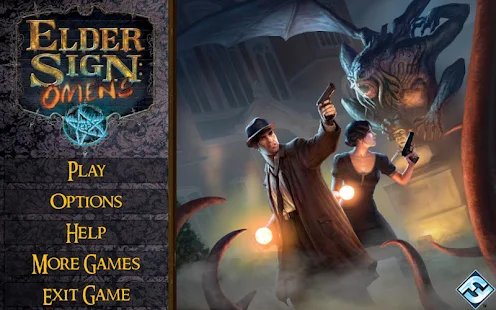
It’s been four-and-a-half years now that I’ve been playing the Elder Sign: Omens app. That’s fairly astounding. I’m not apt to play anything over and over and over—this and the Vampire: Bloodlines PC game are notable exceptions.
What gives Elder Sign: Omens its longevity on my phone and tablet is partly its portability: I can play a turn or three while riding in the car, for example. But the main reason is undoubtedly the tens of thousands of permutations for building a four-person team from a pool of 32 characters.
In previous posts I’ve discussed strategies for using different teams against the seven different “ancient ones.” And even a few instances of playing a single character instead of a team. This year I’ve taken a slightly different tack, assembling teams by theme. Allow me to introduce you to the four so far—and one in the wings.
“Charlie’s Angels”
This team was assembled on a whim, based on the fact that there’s a Charlie among the 32 characters, and that the game has so many female characters with kick-ass special abilities. For this team I chose Jenny Barnes, Amanda Sharpe, Diana Stanley, and Charlie Kane—in that line-up order.
Jenny and Amanda have long been two of my favorites: Jenny almost always has the bonus red and yellow dice at hand, and Amanda isn’t limited to one task per roll—if she’s got the results to solve several, she can. I added Diana because she’s a monster hunter, sort of a combat specialist, which seemed legit for the theme. As for Charlie, I’ve always thought lame his special ability to gain extra trophies by helping an investigator who failed a task; I plan for characters to succeed. But his name’s Charlie, so there you go.
It’s a very good group against pretty much any of the ancient ones. But I’ve played those three ladies in so many other teams that “Charlie’s Angels” didn’t hold many surprises. What did surprise me was Charlie’s effectiveness—which brings me to team two …
“I Got Your Back”
In this case I chose four investigators I’ve never really liked. But it occurred to me that they each have a “help someone out” ability, so why not band them together? Dr. Carolyn Fern restores sanity and Dr. Vincent Lee restores stamina; Charlie Kane and Rex Murphy chip in similarly on a failed task, but while Charlie gets extra trophies, Rex gets an extra clue.
This team-up proved surprisingly effective! Carolyn and Vincent prevent team members from wasting turns and trophies in the first-aid station. Charlie and Rex proved helpful in making failed tasks yield the team at least some repayment. The only trouble was that while Charlie and Rex were always well-equipped, Carolyn and Vincent were often left with empty backpacks. At times I even let them spend a turn in the lost-and-found department to reequip while Charlie and Rex faced down the toughest tasks.
Of the many teams I’ve assembled, “I Got Your Back” is distinctly the most effective. (I suspect there’s a life lesson in that.)
“Greed Is Good”
This team was built of investigators who got a little something extra each time they completed a chosen task. Monterey Jack gets a bonus unique item (red die) when landing a unique item. With Bob Jenkins it’s common items (yellow die), and with Dexter Drake it’s an extra spell. Joe Diamond gets to use each clue twice, which is more stinginess than actual greed, but he’s closer to the greed theme than the remaining 27 investigators.
The results from this team swung between extremes. On the one hand it meant that the investigators each quickly built a stockpile of items. The trouble was that it meant an overabundance of one particular type for each and a paucity of others. For example Joe often had more common items than he could ever actually use, but other items suffered. Even Joe tended to load up on clues more than anything else.
In situations where the game locked out one type of item, that investigator was screwed. (Especially painful in the Dark Pharaoh adventure, where nearly every day blocks out one thing or another.) I began to send the affected investigator to first aid, lost and found, or souvenir shop that turn. It proved to be a fairly effective strategy.
Joe’s clue ability proved to be the most effective of the four, followed closely by Dexter’s spells (a surprise), then Jack’s unique items. Bob’s common items definitely lagged behind the others, though the food and drink common items kept him in relatively good shape.
I’ve since replaced Joe with Tony Morgan, who gains an extra trophy when he kills a monster—which feels more suited to the theme. That extra trophy comes in handy for buying elder signs and equipment against the lower-powered ancient ones, and ally aid against the Dark Pharaoh.
Although not as effective as the “I Got Your Back” team, “Greed Is Good” turned out to be exciting. The team either scored wild success or crashed and burned. Mainly crash and burn against Ithaqua. That final ancient one was felled eventually, but it took more than half a dozen attempts.
“Immunity Deal”
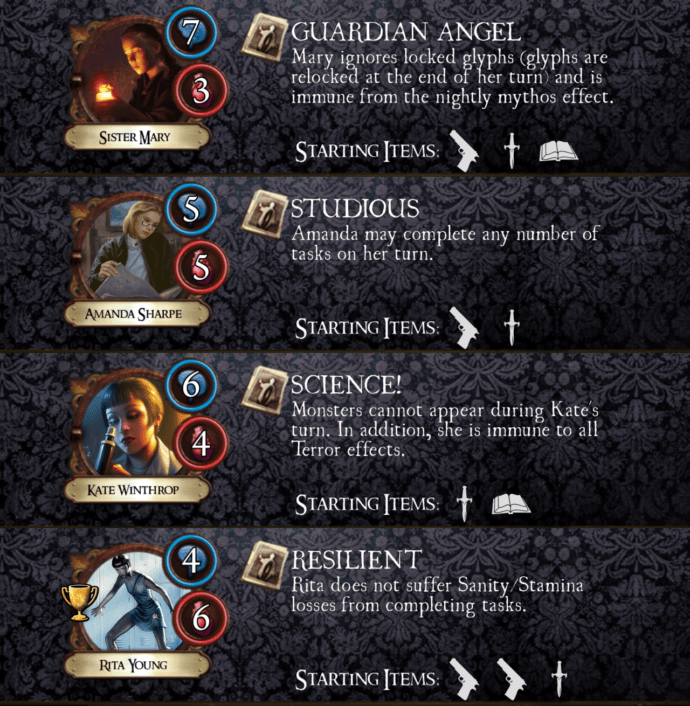
The theme with this team—which I’m currently playing—is immunity from one game effect or another. Sister Mary is immune to locked glyphs. Amanda Sharpe (mentioned earlier) is not limited to one task per roll. Kate Winthrop is immune to terror effects, and monsters cannot appear on her turn. Rita Young is immune to Sanity and Stamina losses from hazardous attacks.
This one has been tougher to succeed with, except (surprisingly) against the Dark Pharaoh! After losing several times to His Lordship, it occurred to me to try different allies. Instead of the Mender of Flesh (spend two trophies to heal two Sanity and Stamina) and the Guiding Spirit (spend two trophies to ignore daily restrictions on one type of equipment or another), I used the ally who adds a red die and the one who adds a yellow die (can’t recall their names). With that change I defeated Nyarlathotep prettily handily.
Ithaqua I’m still battling, having already failed a half-dozen times, many without even leaving the museum for Alaska!
“Ch-ch-ch-changes”
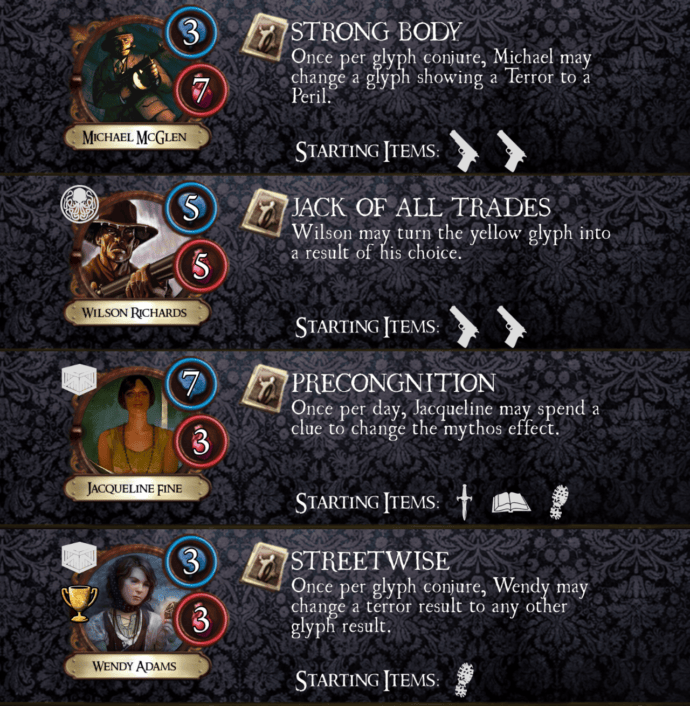
Next up will be a team of characters who can modify dice icons and midnight doom effects: Michael McGlen (changes a Terror to a Peril), Wilson Richards (changes the yellow die face to whatever he wants), Jacqueline Fine (changes the nightly mythos effect), and Wendy Adams (changes a terror to whatever she likes).
Other Possibilities?
I’d love to try a monster-hunter team, but there are only two investigators with related abilities, and it’s a minor aspect of the game, meaning they’ll almost certainly fail again and again. But maybe with a couple of investigators whose illustrations include guns?
Now that the crunch of Popcorn Press’s d6xd6 CORE RPG Kickstarter is over, I’ve returned to taking brief sanity breaks (ironically) with Fantasy Flight’s Elder Signs: Omens game on my Nexus 7.
If you’ve not been following my blog, I rave about this game from time to time. Having beaten all the “demon Gods” several times with various parties of four investigators, I’ve taken to tackling them again with single characters—which gives some surprising insights into those characters’ abilities, the game design itself, and the structure of each threat.
So far, Yig, Tsathoggua, Hastur, Azathoth, Cthulhu, The Dark Pharaoh (Nyarlathotep’s avatar), and Ithaqua have each fallen before the lone efforts of Jenny Barnes, Joe Diamond, Wendy Adams, Gloria Goldberg, and Luke Robinson. Jenny, Wendy, and Luke were particularly effective against them all.
More recently, I’ve been trying to defeat all those Ancient Ones with Leo Anderson alone. All but one have been bested fairly easily by Leo’s ability to equip heavily with his extra trophy reward; and The Dark Pharaoh in particular succumbed readily to Leo’s constant powering of allies.
Ithaqua is proving a harder nut to crack. Three times now I’ve made it to the very last battle then run out of steam. Even little Wendy Adams had less trouble surviving the Alaskan wilds with enough gear to give Ithaqua a smack-down. And considering her tiny health rating, the penalties for starvation, and how likely one’s horses are to fall into a ravine with all supplies near the end, that’s saying something.
Leo’s ability just doesn’t serve well here. He needs time to shop, and time is in short supply when wolf packs are multiplying on the board.
I’m tempted to just set him aside and start over from Yig with Ashcan Pete (my next planned solo adventurer). But the completist in me says “Give Leo another try or two.”
Wish me luck!
(Cheat Note: I’ve just discovered that you can lock up to three dice on one spell, simply by clicking more than one. This seems an unintentional bug, but I’m now using it as a feature!)